

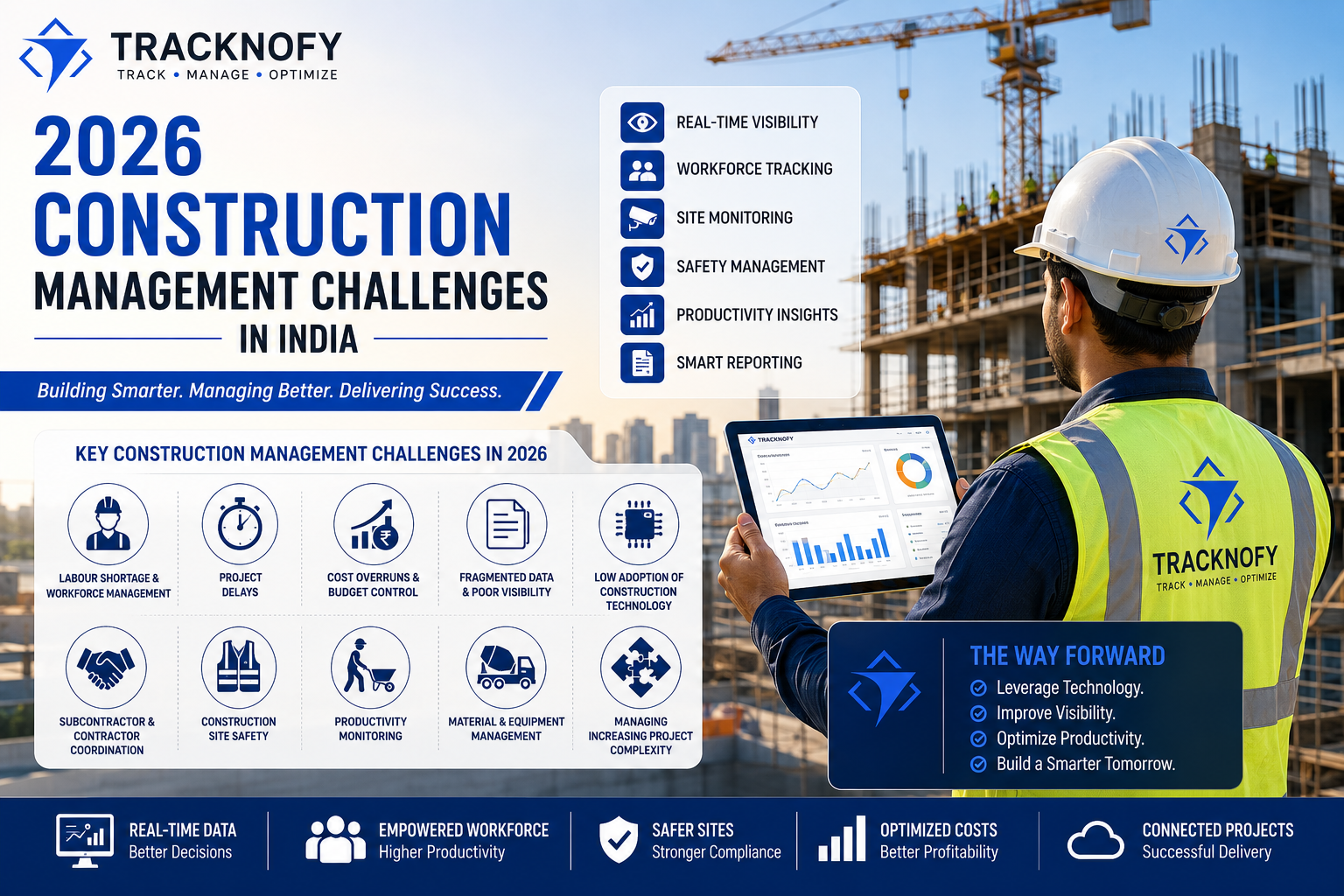
Key Industry Challenges and Smart Solutions
India’s construction industry is entering 2026 with enormous growth opportunities — but also a new set of challenges. From infrastructure and residential development to commercial buildings, data centres, highways, metro projects and industrial facilities, the scale and complexity of construction projects are increasing rapidly.
The Indian construction market is projected to reach approximately ₹25.31 trillion in 2026, highlighting the sector’s strong growth trajectory. At the same time, labour shortages, fragmented project data, material delays, cost overruns, subcontractor coordination and slow technology adoption continue to affect project delivery.
For construction companies, the question in 2026 is no longer simply how to build faster. It is how to achieve better project visibility, stronger workforce management, improved safety, tighter cost control and predictable project execution.
This is where construction management technology and real-time site monitoring are becoming increasingly important.
What Are the Biggest Construction Management Challenges in India in 2026?
The Indian construction industry faces several interconnected challenges. While every project is different, the following issues are among the most important for construction companies, contractors and project managers.
1. Skilled Labour Shortage and Workforce Management
Labour remains one of the biggest challenges in Indian construction.
India’s construction sector employs more than 70 million workers, but the industry is facing a growing shortage of skilled professionals. One 2026 report estimates that India could require nearly 395,000 additional construction project professionals by 2035.
For project managers, this creates several operational problems:
- Difficulty finding skilled workers
- Labour productivity variations
- High workforce turnover
- Attendance and workforce tracking challenges
- Difficulty allocating workers efficiently
- Limited visibility into manpower deployment
- Delays caused by workforce shortages
Traditional attendance registers and manual workforce tracking make it difficult to understand what is actually happening on a large construction site.
Digital workforce management can provide better visibility into attendance, manpower deployment, productivity and workforce movement, helping construction managers make faster decisions.
2. Construction Project Delays
Project delays remain a major concern across the Indian construction industry.
Delays can originate from multiple sources, including:
- Material procurement issues
- Labour shortages
- Poor coordination between contractors
- Design changes
- Approval delays
- Weather conditions
- Equipment availability
- Site-level productivity issues
- Inadequate project monitoring
The challenge is that construction managers often discover problems only after they have already affected the project schedule.
This makes real-time construction site monitoring increasingly valuable.
Instead of relying entirely on periodic reports, project managers can use digital tools to track site activities, identify deviations and respond to issues earlier.
3. Cost Overruns and Budget Control
Construction cost management has become more complex due to changing material prices, labour costs, equipment expenses and project requirements.
Even a small delay can create a chain reaction:
Delay → Lower productivity → Higher labour costs → Extended equipment usage → Increased overheads → Project cost overrun
Effective construction project management therefore requires continuous visibility into both project progress and resource utilisation.
Construction companies need systems that help them monitor project performance against planned schedules and budgets rather than waiting until the end of a project phase to identify cost problems.
4. Fragmented Data and Poor Project Visibility
One of the biggest challenges in modern construction is not necessarily a lack of data — it is having too much disconnected data.
Project information may be spread across:
- Excel spreadsheets
- WhatsApp conversations
- Paper registers
- Emails
- Contractor reports
- Attendance records
- Site photographs
- Project management software
- Billing systems
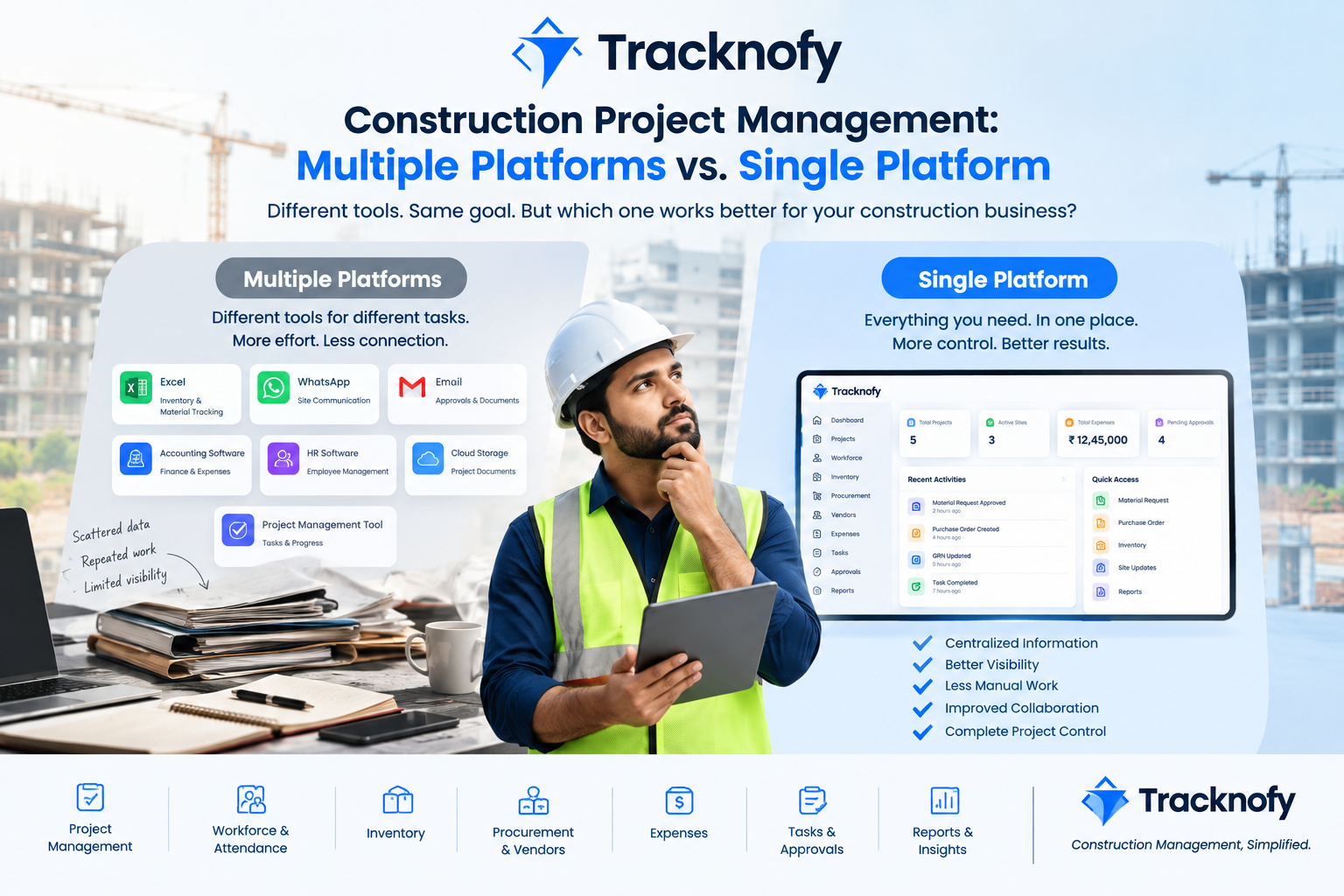
This fragmentation makes it difficult for project managers to get a single, reliable view of project status.
A 2026 report on construction in India highlights fragmented data, limited visibility, manual processes and reactive decision-making as persistent industry challenges.
The solution is moving toward centralized construction management systems that connect site information and project workflows.
5. Low Adoption of Construction Technology
Despite rapid advances in technology, many construction processes in India remain heavily dependent on manual workflows.
Industry discussions in 2026 continue to highlight gaps in the adoption of technologies such as BIM, ERP, drones, AI and centralized data platforms.
The problem isn’t simply whether a company has technology. The bigger question is whether technology is actually integrated into daily construction operations.
For example, a company may use project management software but still depend on manual attendance sheets and phone calls for workforce monitoring.
The next phase of construction technology in India will therefore focus on connecting different operational processes instead of using isolated digital tools.
6. Subcontractor and Contractor Coordination
Large construction projects often involve multiple contractors, subcontractors, consultants, suppliers and specialist teams.
Managing these stakeholders can become extremely complicated.
A delay by one contractor can affect several other activities. Poor communication can result in:
- Rework
- Schedule conflicts
- Resource clashes
- Quality problems
- Billing disputes
- Productivity losses
Recent developments also show increasing attention to subcontracting transparency. In August 2026, India’s road transport ministry announced plans to use GST records to examine multiple layers of subcontracting in road projects, partly in response to concerns around unusually low bids and construction quality.
Better digital documentation and contractor visibility can help construction companies establish greater accountability throughout the project lifecycle.
7. Construction Site Safety
Safety remains one of the most critical areas of construction management.
Construction sites involve heavy machinery, elevated work, electrical systems, moving vehicles, excavation and constantly changing working environments.
Traditional safety inspections can identify problems, but they are often periodic rather than continuous.
Technology is increasingly being used for:
- Safety inspections
- Worker monitoring
- Incident reporting
- Site documentation
- Hazard identification
- Compliance tracking
- Video-based safety analytics
The broader construction technology market is also moving toward computer vision and AI-powered safety analytics that can identify potential hazards and improve safety oversight.
For Indian construction companies, the opportunity is to combine technology with strong safety procedures rather than treating technology as a replacement for human supervision.
8. Productivity Monitoring
Construction productivity is difficult to measure because work happens across changing locations, teams and activities.
Managers need answers to questions such as:
- How many workers are currently on site?
- Which activities are progressing?
- Are teams working according to schedule?
- Where are productivity bottlenecks occurring?
- Which project areas require additional manpower?
- Is actual progress matching planned progress?
Without reliable information, project managers may have to depend on assumptions or delayed reports.
Construction productivity tracking provides a more data-driven approach by connecting workforce information, project schedules and site activity.
9. Material and Equipment Management
Materials and machinery represent significant project costs.
Poor material management can lead to:
- Material shortages
- Excess inventory
- Wastage
- Theft or pilferage
- Idle equipment
- Procurement delays
- Increased project costs
India is also seeking to strengthen domestic production of advanced construction equipment. In August 2026, the government was reported to be preparing a ₹1.2 billion incentive programme aimed at increasing domestic manufacturing of high-value construction and infrastructure equipment.
As construction projects become more equipment-intensive, companies will need better systems for tracking equipment utilisation, availability and site requirements.
10. Managing Increasing Project Complexity
Construction projects are becoming larger, faster and more technically complex.
India is seeing major investment across:
- Metro rail
- Highways and expressways
- Airports
- Data centres
- Renewable energy
- Industrial facilities
- Logistics infrastructure
- Residential development
- Commercial real estate
For example, India has a significant data-centre and semiconductor construction pipeline, increasing demand for highly coordinated construction delivery.
As project complexity increases, manual coordination becomes increasingly difficult.
This makes digital construction management a strategic necessity rather than simply an optional upgrade.
How Can Technology Solve Construction Management Challenges?
The construction industry is increasingly moving from reactive management toward data-driven construction project management.
Technologies such as AI, BIM, IoT, cloud platforms, computer vision, drones and digital twins are helping construction companies improve planning, monitoring and decision-making.
Real-Time Construction Site Monitoring
Real-time monitoring provides project managers with better visibility into what is happening at the site.
Instead of waiting for end-of-day or weekly reports, teams can access more current information and identify potential problems sooner.
Digital Workforce Management
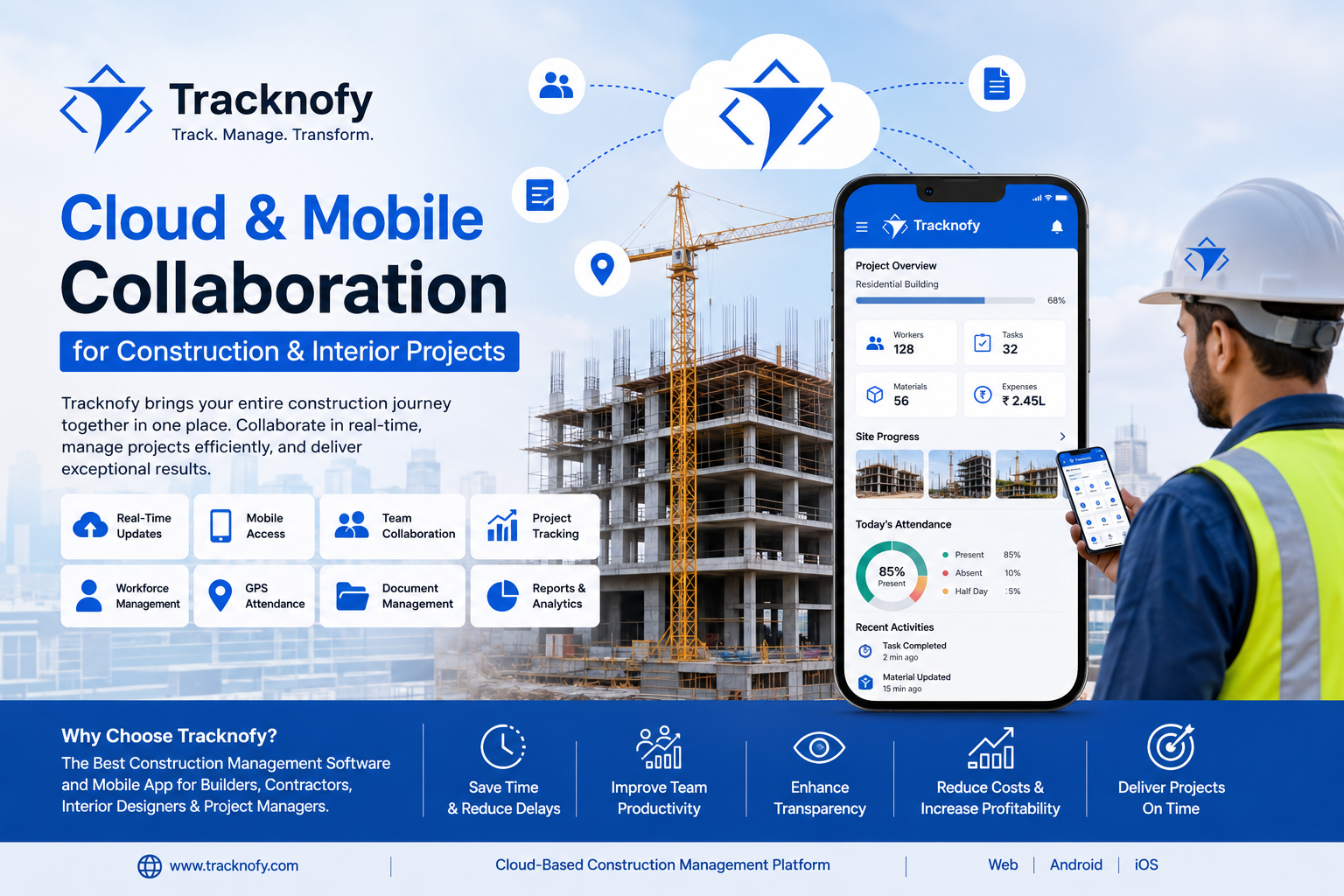
A construction workforce management platform can help organizations track attendance, manpower deployment and workforce activity.
This is particularly valuable for companies managing multiple projects or large teams across different locations.
AI in Construction Management
AI is increasingly becoming part of construction project management.
A 2026 survey found that 52.8% of construction project managers said AI had changed their day-to-day work during the previous 12 months. However, accuracy and trust were identified as the biggest barriers to wider adoption.
This suggests an important lesson: successful AI adoption in construction will depend not only on powerful technology, but also on reliable data, human oversight and practical workflows.
BIM and Digital Construction
Building Information Modeling (BIM) allows project stakeholders to work with structured digital representations of buildings and infrastructure.
When combined with project management systems, BIM can improve coordination, planning and information sharing.
Connected Construction Data
The future of construction management is increasingly about connecting information from different parts of the project.
A connected platform can help bring together:
People + Projects + Progress + Productivity + Safety + Data
This creates a more complete view of project performance.
The Role of Tracknofy in Modern Construction Management
As Indian construction projects become more complex, construction companies need better visibility into their workforce and site operations.
This is where platforms such as Tracknofy can play an important role.
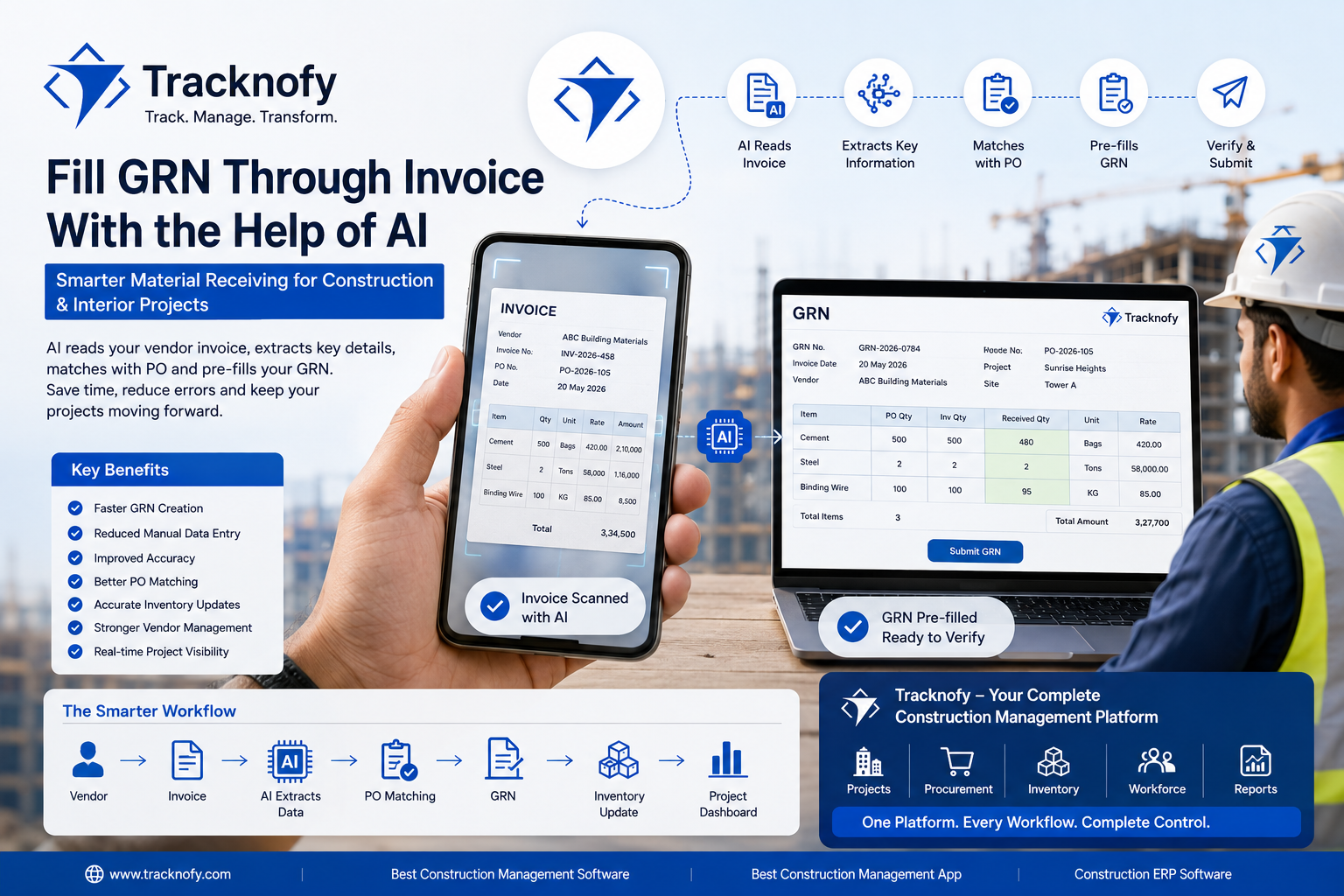
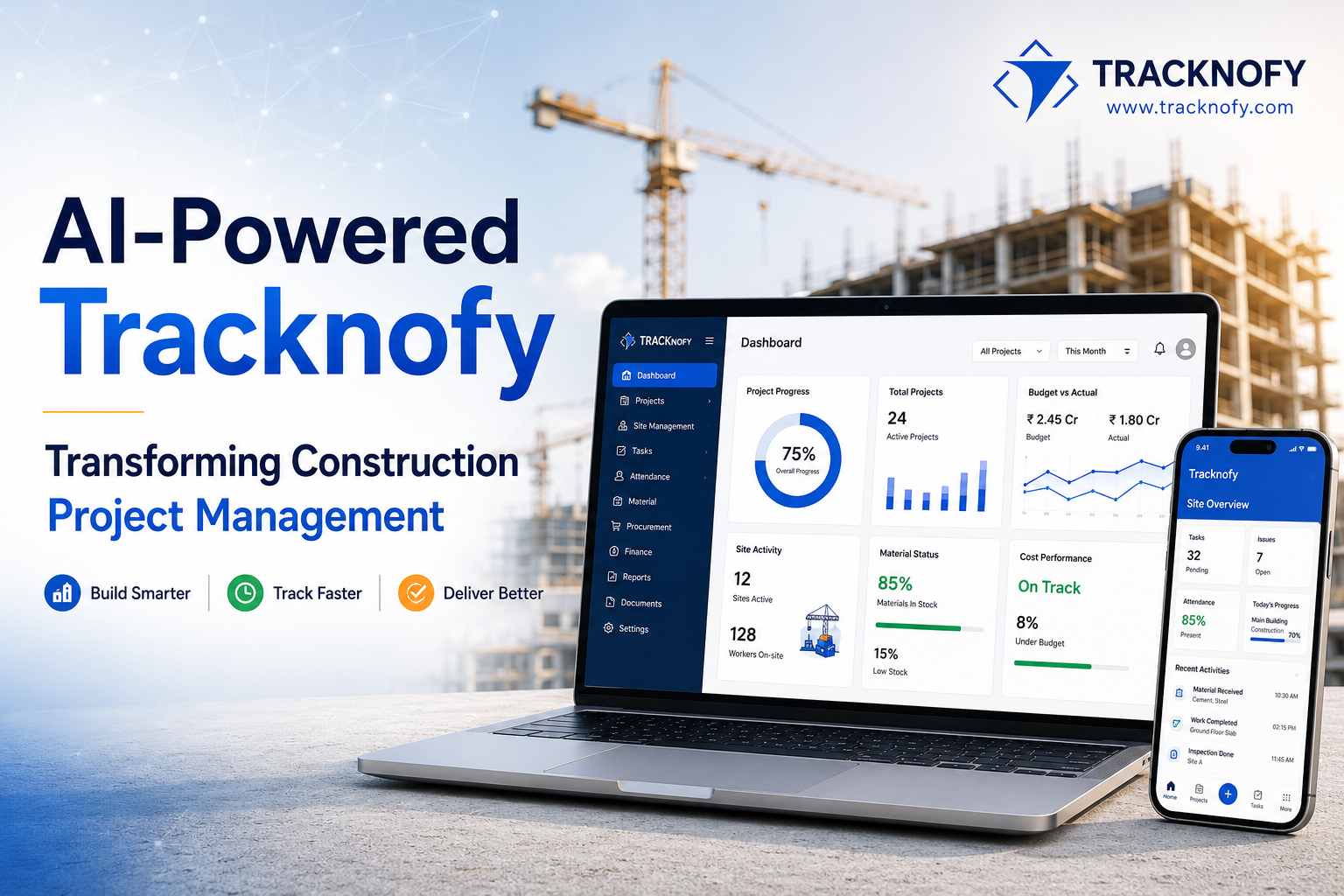
A modern construction management solution can help organizations move away from fragmented manual processes toward a more connected approach to workforce tracking, attendance management, site monitoring and operational visibility.
The objective is not simply to digitize existing paperwork.
The real goal is to give construction managers the information they need to answer critical questions quickly:
Who is on site?
Where is the workforce deployed?
Is manpower being utilized effectively?
Are site activities progressing as planned?
Where are operational bottlenecks emerging?
When these questions can be answered quickly, project managers can take action before small operational issues become major project problems.
2026 Construction Industry Trends in India
Looking ahead, several trends are likely to influence construction management in India.
1. AI-Powered Construction Management
AI will increasingly support planning, forecasting, reporting, risk identification and site intelligence.
2. Real-Time Project Monitoring
Construction companies will increasingly demand real-time visibility instead of relying entirely on periodic reports.
3. Digital Workforce Management
As skilled labour becomes harder to manage at scale, digital workforce tracking will become increasingly important.
4. Integrated Construction Platforms
Companies will move away from isolated tools toward platforms that connect workforce, project and site data.
5. BIM and Digital Twins
BIM, digital twins and connected project data will play a greater role in complex infrastructure and commercial projects.
6. Data-Driven Decision Making
Construction management will increasingly depend on accurate operational data rather than assumptions and delayed reporting.
7. Technology-Assisted Safety
AI, computer vision and connected devices will increasingly support construction safety and compliance.
What Construction Companies Should Prioritize in 2026
For construction companies looking to improve project execution, technology adoption should focus on practical business outcomes.
A strong construction technology strategy should prioritize:
- Real-time visibility
- Workforce productivity
- Project schedule monitoring
- Construction site safety
- Contractor accountability
- Data accuracy
- Centralized reporting
- Mobile accessibility
- Integration with existing systems
- Scalable digital workflows
The most successful construction companies won’t necessarily be those using the most technology.
They will be the companies using the right technology to solve the right operational problems.
Conclusion
The construction management challenges in India in 2026 are becoming more complex as project sizes, workforce requirements and infrastructure ambitions continue to grow.
Labour shortages, project delays, cost overruns, fragmented data, subcontractor coordination, safety concerns and limited real-time visibility can all affect construction project performance.
At the same time, technologies such as AI, BIM, IoT, digital workforce management, computer vision and real-time construction site monitoring are creating new opportunities to improve project execution.
For construction companies, the path forward is clear: move from reactive management to proactive, data-driven construction management.
With better workforce visibility, connected project data and real-time operational insights, construction teams can make faster decisions, improve productivity and build with greater confidence.
2026 is not just about building more in India. It is about building smarter.